Value Betting on Exchanges: How to Find & Exploit Value Odds
Value betting exchange, Tired of battling the bookmaker’s built-in advantage? For decades, traditional sports betting has been a one-way street: you bet against the “house,” and the house always has an edge, known as the margin or ‘vig’. But what if you could remove the house and bet directly against other people?
This is where the concept of a value betting exchange comes into play. It’s a peer-to-peer (P2P) marketplace that fundamentally changes the game.
Unlike a bookmaker who sets the odds to guarantee their own profit, an exchange is an open platform where users set the odds themselves. This creates a dynamic, stock-market-like environment where savvy bettors can find “value”—odds that are more favorable than the true probability of an outcome.
This guide will demystify the world of betting exchanges. We’ll break down how they work, explain the critical concepts of “back” and “lay” betting, and show you exactly how to identify and exploit value to gain a long-term mathematical edge.
Table of Contents
- What Is a Betting Exchange?
- How Does a Betting Exchange Work? (A Step-by-Step Example)
- Back and Lay Betting Explained
- The ‘Back’ Bet: Betting For an Outcome
- The ‘Lay’ Bet: Betting Against an Outcome
- Betting Exchange vs. Traditional Bookmaker
- What is “Value” in Betting?
- How to Find Value on a Value Betting Exchange
- Understanding True Probability vs. Market Odds
- Spotting Market Inefficiencies
- Using Lay Betting to Capitalize on Over-valued Odds
- Advanced Strategies for a Value Betting Exchange
- Benefits (Pros) of Using Exchanges for Value Betting
- Risks (Cons) of Exchanges
- Understanding Liability (The Big One)
- The Risk of Unmatched Bets
- People Also Ask
- Is an exchange better than a bookmaker?
- What is the risk of a lay bet?
- Can you make consistent money on a betting exchange?
- Conclusion: Your Path to Smarter Betting
- Frequently Asked Questions
What Is a Betting Exchange?
Think of a betting exchange as a stock market for sports. Instead of buying and selling shares of a company, users “buy” (back) and “sell” (lay) the outcomes of sporting events.
The exchange itself (like major players Betfair, Smarkets, or Matchbook) is just the platform or intermediary. It doesn’t set odds, take bets, or have any financial interest in who wins. It simply connects two people with opposing views on an event.
How does the exchange make money? Instead of building in a profit margin, it charges a small commission on a user’s net winnings for a specific market. This fundamental difference is what allows for fairer odds and the possibility of finding true value.
How Does a Betting Exchange Work? (A Step-by-Step Example)
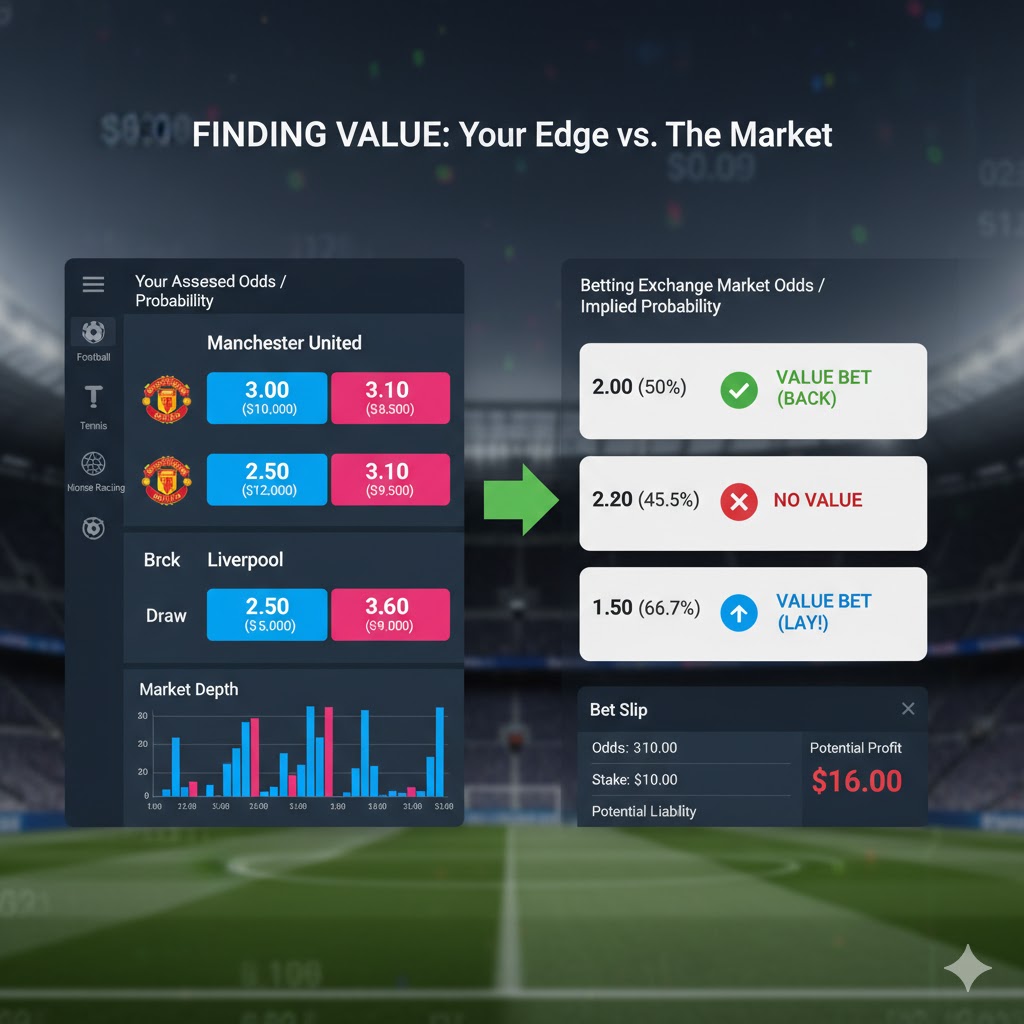
The P2P model can seem confusing at first, so let’s use a simple example: a Premier League match between Manchester United and Liverpool.
- Step 1: The ‘Backer’ Proposes a Bet
- You believe Manchester United will win. You want to place a $10 bet on them at odds of 3.0.
- You place a back bet request on the exchange: “I want to bet $10 on Man Utd at 3.0.”
- Step 2: The ‘Layer’ Accepts the Bet
- Another user, let’s call her Sarah, sees your request. She believes Man Utd will not win (meaning they will lose or draw).
- She decides to play the role of the bookmaker and lay your bet. She accepts your $10 stake.
- Step 3: The Exchange Holds the Stakes
- The exchange now holds your $10 stake.
- Crucially, the exchange also holds Sarah’s liability. If you win, she has to pay you $20 ($10 stake * (3.0 odds – 1)). The exchange locks this $20 from her account to ensure you get paid.
- Step 4: The Result
- If Man Utd wins: You win! The exchange gives you your $10 stake back, plus the $20 from Sarah’s liability. You have a total profit of $20.
- If Man Utd loses or draws: Sarah wins. The exchange gives her your $10 stake.
- Step 5: The Commission
- The winner pays the commission. If you won $20, and the exchange has a 2% commission rate, you would pay $0.40, leaving you with a net profit of $19.60. If Sarah won your $10, she would pay a $0.20 commission.
Back and Lay Betting Explained
This is the most important concept to grasp. Every bet on an exchange has two sides: the backer and the layer.
The ‘Back’ Bet: Betting For an Outcome
A back bet is the standard, traditional bet you’ve always known.
- You are betting for something to happen.
- You back a horse to win.
- You back a team to win.
- You back “Over 2.5 Goals” to happen.
If your selection wins, you win the profit based on the odds. If it loses, you lose only your stake.
The ‘Lay’ Bet: Betting Against an Outcome
A lay bet is the game-changer. This is where you act as the bookmaker.
- You are betting against something happening.
- You lay a horse (meaning you bet it will not win).
- You lay a team (meaning you bet they will lose or draw).
- You lay “Over 2.5 Goals” (meaning you bet the match will have 0, 1, or 2 goals).
If the outcome you are laying doesn’t happen, you win the backer’s stake. However, if it does happen, you must pay the backer their winnings. This potential payout is your liability.
Betting Exchange vs. Traditional Bookmaker
The differences are stark and directly impact your ability to find value. Traditional bookmakers, for instance, bake a profit margin (or “vig”) into their odds, which can range from 5% to 10%. This means their odds are always worse than the true probability. Exchanges remove this margin.
Here’s a side-by-side comparison:
| Feature | Betting Exchange | Traditional Bookmaker |
| Opponent | Other users (Peer-to-Peer) | The “House” (Bookmaker) |
| Odds | Set by the market (users) | Set by the bookmaker |
| Profit Model | Small commission on winnings | Built-in profit margin (“Vig”) |
| Betting Options | Back (bet to win) & Lay (bet to lose) | Back bets only |
| Transparency | High: See market depth and money | Low: Odds are fixed |
| Finding Value | Excellent: Market reflects true probability | Difficult: Odds are skewed for house profit |
| Restrictions | Winners are rarely limited | Winners are often restricted or banned |
A beginner’s guide to sports betting terminology
What is “Value” in Betting?
Before we can find it, we must define it. “Value” in betting is a simple concept:
Value exists when the odds you are offered are higher than the true statistical probability of that outcome.
It’s not about picking guaranteed winners. It’s about making a long-term mathematical investment.
The Coin Toss Analogy:
A fair coin toss has a 50% chance of landing on Heads. The “true odds” are 2.0 (or +100).
- If a bookmaker offers you odds of 1.90, there is no value. You are being underpaid for the risk.
- If another person offers you odds of 2.10, there is positive value. You are being overpaid for the risk.
You might still lose that single coin toss, but if you made that 2.10 bet 1,000 times, you would be guaranteed to make a profit. A value betting exchange is simply a platform that allows you to find these “2.10 coin tosses” in the real world.
How to Find Value on a Value Betting Exchange
This is the core skill of a professional bettor. You are no longer just predicting a winner; you are predicting whether the market’s price is right or wrong.
Understanding True Probability vs. Market Odds
First, you must learn to convert odds into implied probability. The formula is simple:
Implied Probability = 1 / Decimal Odds
- If the exchange odds are 2.50, the implied probability is
1 / 2.50 = 0.40, or 40%. - If the exchange odds are 1.80, the implied probability is
1 / 1.80 = 0.555, or 55.5%.
Value is found when your assessment of the probability is different from the market’s.
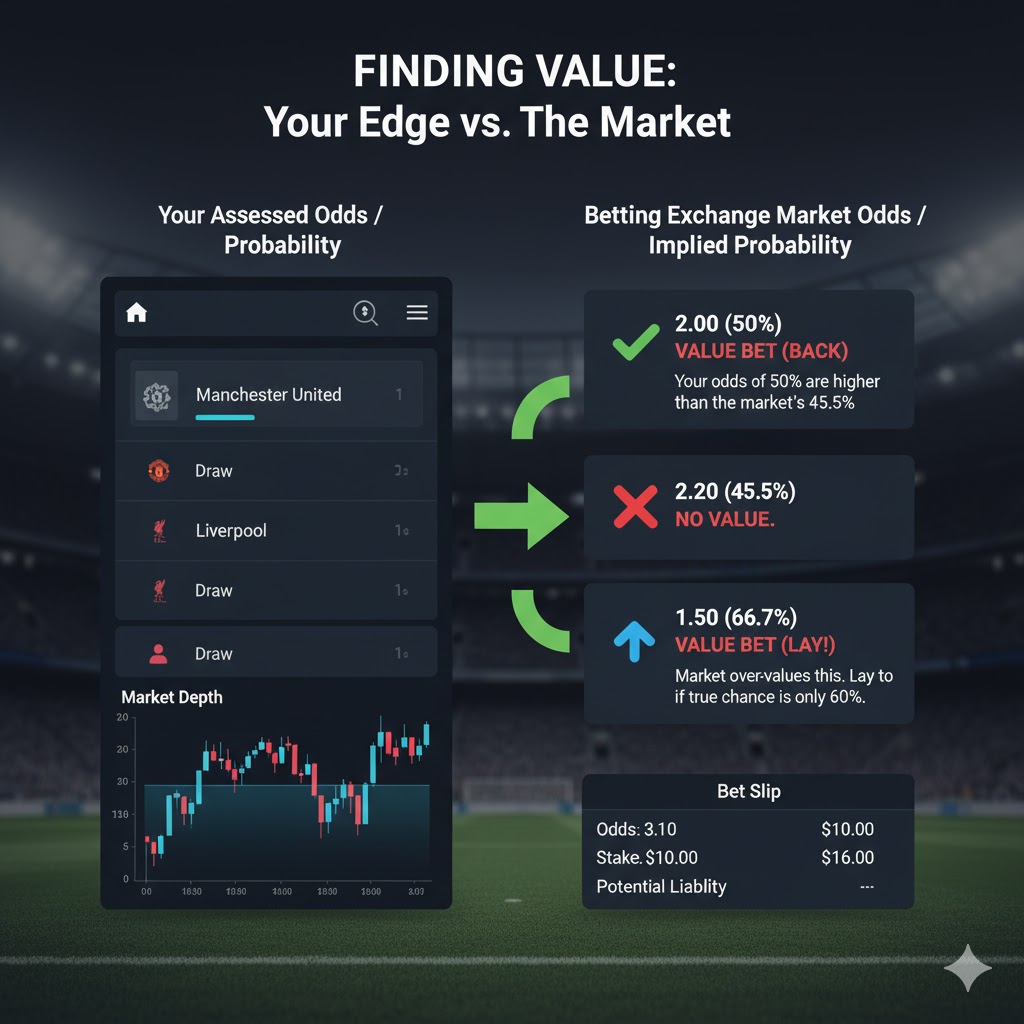
Example: You are analyzing a tennis match. The market has Player A at 2.20 (45.5% chance). However, based on your own research (form, head-to-head, surface), you believe Player A has a 50% chance to win.
Since your assessment (50%) is higher than the market’s implied probability (45.5%), this is a value back bet.
Spotting Market Inefficiencies
Betting exchanges are “efficient markets,” but they aren’t perfect. The odds are simply the collective opinion of all the money in the market. Sometimes, that collective opinion is wrong.
Value can often be found in:
- Niche Markets: There is less money and research in lower-league football or less popular sports, making odds less accurate.
- Early Markets: When odds are first released, they are “soft” and haven’t been shaped by professional money yet.
- Live Betting: Markets often overreact to key events like a goal or a red card, creating temporary value opportunities.
Using Lay Betting to Capitalize on Over-valued Odds
This is the other, powerful side of value betting. Sometimes, you’ll analyze a match and find that the market loves a certain team or player.
Example: A “hype” team is playing, and the public has backed them heavily. Their odds to win are 1.50 (an implied 66.7% chance). You analyze the match and believe their true chance is only 60%.
The market is over-valuing them. This is a perfect opportunity for a value lay bet. You bet against them at 1.50, effectively taking the 60% side of the equation with an implied risk of 66.7%. In the long run, this is a profitable position.
Advanced guide to statistical modeling in sports
Advanced Strategies for a Value Betting Exchange
Once you master back and lay value, you can explore “trading.” This involves placing multiple bets on the same market to lock in a profit regardless of the result.
- Arbitrage: This involves backing at high odds on one platform (or early on an exchange) and laying at lower odds on the exchange. This “Back High, Lay Low” strategy guarantees a small profit.
- “Greening Up”: This is trading in-play. You might back a team at 3.0. If they score a goal, their odds to win will drop to 1.80. You can then lay them at 1.80 for a calculated stake, guaranteeing you win the same amount of money whether they go on to win or not.
Our complete guide to betting exchange trading strategies
Benefits (Pros) of Using Exchanges for Value Betting
The advantages for a serious bettor are significant:
- Better Odds: By removing the bookmaker’s margin, the odds are almost always better.
- The Power to Lay: You can finally profit from your knowledge that a team is over-rated, not just when a team is under-rated.
- Market Transparency: You can see the “market depth”—how much money is waiting to be backed or layed at different odds.
- Trading Opportunities: You can trade in and out of positions, just like a stock trader, to lock in profit.
- No Winner Restrictions: Traditional bookmakers hate winners and will limit their stakes. Exchanges want winners because they generate more commission.
Risks (Cons) of Exchanges
It’s not all easy money. The exchange model introduces new risks you must manage.
Understanding Liability (The Big One)
This cannot be overstated. When you place a back bet, your risk is limited to your stake. If you bet $10, you can only lose $10.
When you place a lay bet, your risk is your liability.
Example: You lay $10 on a horse at high odds of 10.0.
- If the horse loses (your lay bet wins): You win the backer’s $10 stake.
- If the horse wins (your lay bet loses): You must pay the backer their winnings. Your liability is
$10 * (10.0 - 1) = $90.
You risked $90 just to win $10. While this might be a value bet (if the horse’s true chance was even less), you must have the bankroll to cover this potential loss.
The Risk of Unmatched Bets
Your bet is not “on” until another user matches it. If you request odds of 3.5 but the market is only offering 3.0, your bet will sit “unmatched” until the price moves or you change your request. You could miss a value opportunity if your bet is never taken.
People Also Ask
Is an exchange better than a bookmaker?
For a professional or semi-professional bettor focused on value, the answer is almost always yes. The superior odds, transparency, and ability to lay provide a platform for long-term profit.
For a casual bettor who just wants a simple bet with a welcome bonus, a traditional bookmaker might be an easier-to-understand option.
What is the risk of a lay bet?
The main risk of a lay bet is your liability. Because you are paying out if the outcome does happen, you can lose significantly more than the stake you are trying to win, especially when laying at high odds. Always check your liability before confirming a lay bet.
Can you make consistent money on a betting exchange?
It is possible, but it is extremely difficult. The global sports betting market is valued at over $194 billion, and you are competing against very smart individuals and syndicates.
Making consistent money requires immense discipline, a deep understanding of statistical value, a solid bankroll management plan, and the emotional control to treat it like a business, not a gamble.
BeGambleAware – Advice for responsible gambling
Conclusion: Your Path to Smarter Betting
A value betting exchange is the most powerful tool available to a modern sports bettor. It transforms you from a simple punter into a market trader.
By moving away from the “us vs. the house” mentality and embracing the P2P market, you gain access to fairer odds and the unique power of lay betting.
The key to success is no longer just picking winners. It’s about meticulously finding value—identifying those small, consistent edges where the market price is wrong. It requires patience, research, and a rock-solid understanding of the concepts of back, lay, and liability.
Master these, and you’ll be well on your way to betting smarter, not harder.
Sign up and get our free betting exchange guide
Frequently Asked Questions
What is the commission on a betting exchange?
The commission is a small percentage (typically 2-5%) that the exchange charges on a player’s net winnings from a single market. You do not pay commission on losing bets.
What happens if my lay bet loses?
If your lay bet loses (meaning the outcome you bet against actually happened), you must pay the backer their winnings from your own account balance. This amount is known as your liability and was secured by the exchange when you placed the bet.
Can I use a value betting exchange on my mobile?
Yes, all major betting exchanges have robust mobile apps and websites that offer the full functionality of the desktop platform, including back and lay betting, in-play markets, and account management.
Is value betting the same as arbitrage?
No, but they are related. Value betting is about finding a single bet (back or lay) where the odds are in your favor (a long-term positive expectation). Arbitrage is a specific strategy (often done on an exchange) where you back and lay the same outcome at different odds simultaneously to lock in a small, guaranteed, risk-free profit.
How much money do I need to start on a betting exchange?
You can start with a small amount, such as $50 or $100, to learn the mechanics. However, to absorb the variance of value betting and to properly cover liability on lay bets, a larger, dedicated bankroll is recommended. Never bet more than you can afford to lose.