Table of Contents
- Introduction: The Betting Revolution(hedge bets exchange)
- What Is a Betting Exchange?
- Back and Lay Betting Explained
- What is a ‘Back’ Bet?
- What is a ‘Lay’ Bet?
- Understanding ‘Liability’: The Critical Risk of Lay Betting
- A Practical Example of Liability
- How Does a Betting Exchange Work? (A Step-by-Step Example)
- Step 1: Finding Your Market
- Step 2: Placing a ‘Back’ Bet
- Step 3: Placing a ‘Lay’ Bet (The Other Side)
- Step 4: The Result & Commission
- How to Hedge Bets on an Exchange to Guarantee Profit
- The Hedging Process: A Clear Example
- Calculating Your Guaranteed Profit
- Betting Exchange vs Traditional Bookmaker
- Benefits (Pros) of Using a Betting Exchange
- Risks (Cons) and How to Manage Them
- How to Choose the Best Exchange to Hedge Bets
- People Also Ask (PAA)
- Is an exchange better than a bookmaker?
- What is the biggest risk of a lay bet?
- Can you lose more than your stake on a betting exchange?
- Conclusion: From Bettor to Trader
- Frequently Asked Questions
Introduction: The Betting Revolution
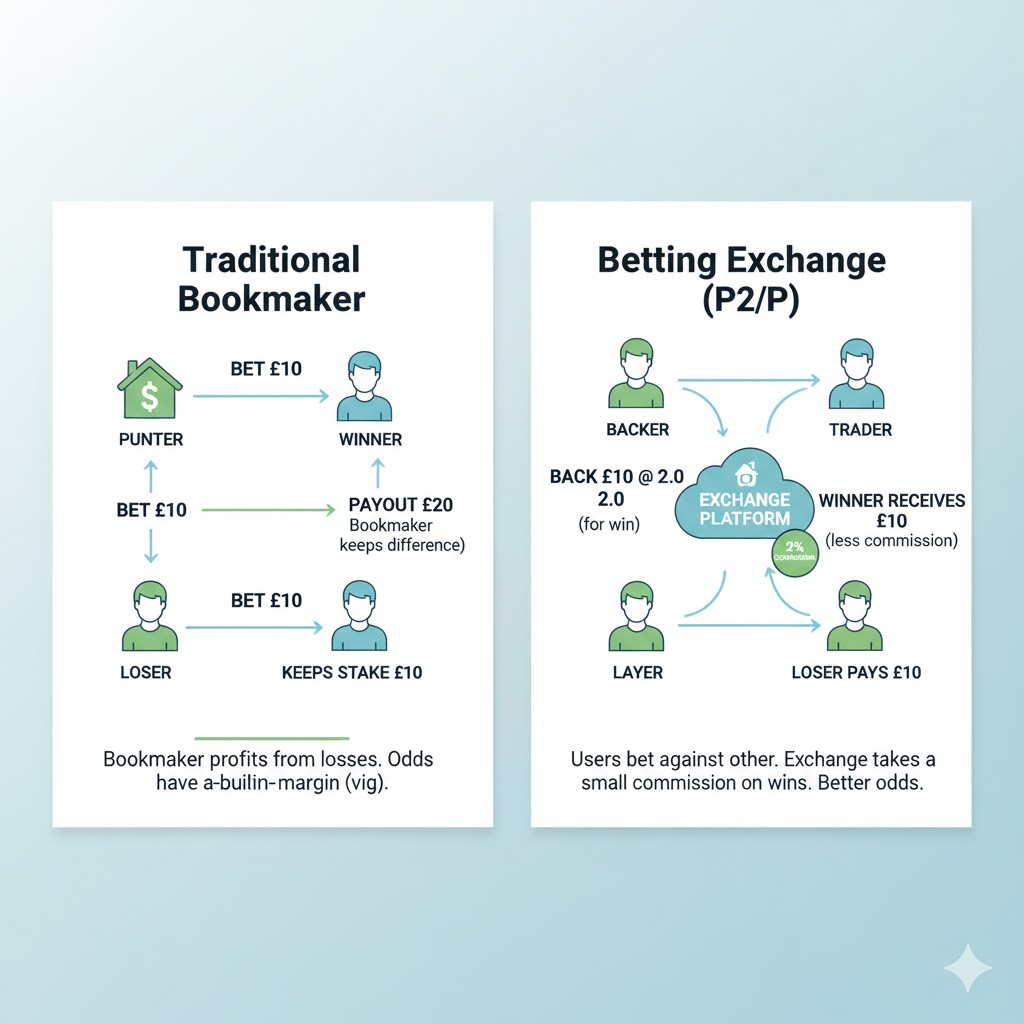
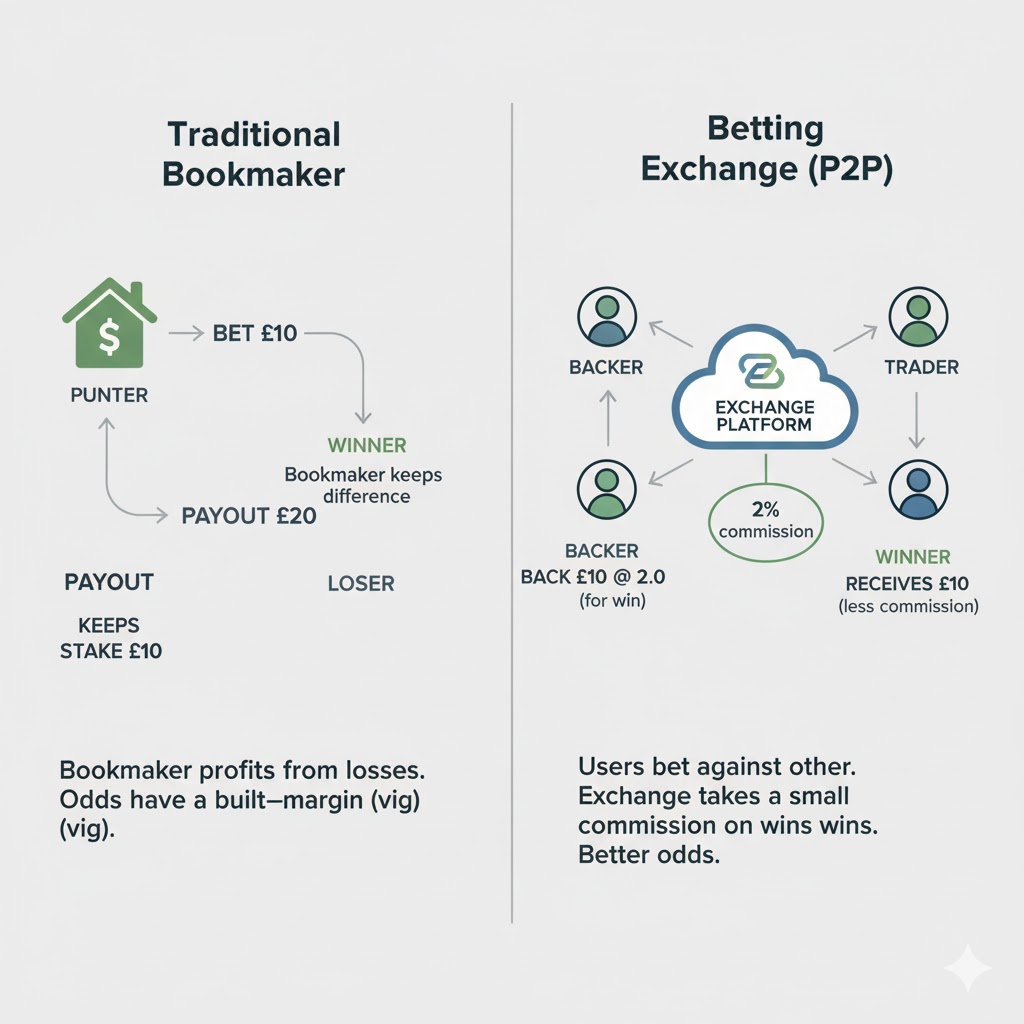
For decades, betting meant one thing: you versus “the house.” You’d go to a traditional bookmaker, see the odds they offered, and place your bet. If you won, they paid you. If you lost, they kept your stake. It was a simple but fundamentally one-sided relationship where the bookmaker always held the mathematical edge.
However, what if you could become the bookmaker? What if you could bet against other people directly, cutting out the middleman and their built-in profit margins?
This is the core concept of a betting exchange. It’s a peer-to-peer (P2P) platform that functions less like a shop and more like a stock market for sports. Consequently, its most powerful feature is that it gives you the unique ability to hedge bets on an exchange, allowing you to lock in a guaranteed profit or minimize a loss before the event even finishes.
This guide will break down everything from the ground up: what an exchange is, how back and lay betting work, and the exact steps to protect your profits through hedging.
What Is a Betting Exchange?
A betting exchange is an online marketplace where users bet against each other, not against a bookmaker.
Think of it like eBay or a stock exchange. One user (a “layer”) offers odds on an outcome not to happen, and another user (a “backer”) accepts those odds, betting on it to happen.
The exchange itself doesn’t care who wins or loses. It simply acts as a neutral third-party, holding the money in escrow and connecting the two users. For providing this service, the platform takes a small commission on the winner’s net profit. This is fundamentally different from a bookmaker, who profits from your losses.
Back and Lay Betting Explained
This is the most critical concept to understand. On an exchange, every bet has two sides.
What is a ‘Back’ Bet?
This is the bet you already know. A back bet is a bet for an outcome to happen.
- Example: You back Manchester United to win their match.
- How you win: Manchester United wins.
- How you lose: Manchester United loses or the match is a draw.
This is identical to betting at a traditional bookmaker.
What is a ‘Lay’ Bet?
This is the game-changer. A lay bet is a bet for an outcome not to happen. When you place a lay bet, you are effectively playing the role of the bookmaker.
- Example: You lay Manchester United to win their match.
- How you win: Manchester United loses OR the match is a draw.
- How you lose: Manchester United wins.
You are accepting someone else’s back bet. You are “laying” odds for them to take.
Understanding ‘Liability’: The Critical Risk of Lay Betting
This concept is essential for your financial safety.
When you place a back bet, your risk is limited to your stake. For instance, bet £10, you can only lose £10.
In contrast, when you place a lay bet, your risk is not your stake. Your risk is your liability. This is the amount of money the exchange requires you to have in your account to pay the backer if their bet wins.
The Liability Formula:
Liability = (Backer’s Stake) x (Decimal Odds – 1)
A Practical Example of Liability
Let’s use a clear example. You decide to lay Manchester United for £10 at decimal odds of 4.0. This means you are offering £10 to someone who wants to back them.
- Your potential profit: £10 (the backer’s stake), minus commission.
- Your potential loss (Liability): £10 x (4.0 – 1) = £30.
Ultimately, you are risking £30 to win £10. The exchange will “lock” this £30 from your balance. If Man U wins, the backer gets their £10 stake back plus your £30 liability. If Man U fails to win (draws or loses), you win the backer’s £10 stake.
How Does a Betting Exchange Work? (A Step-by-Step Example)
To illustrate, let’s walk through a real-world scenario. Imagine a tennis match: Player A vs. Player B.
You log in and see the market. The “Back” odds are typically in blue boxes, and the “Lay” odds are in pink/red boxes.
Step 1: Finding Your Market
You believe Player A will win. The best available odds on the lay side (offered by layers) are 2.5. This is the price you can back at.
Step 2: Placing a ‘Back’ Bet
You decide to back Player A with £50 at odds of 2.5.
- After clicking the 2.5 (blue box) and entering your £50 stake, your bet “matches” instantly with a layer (or multiple layers) who was offering those odds.
- This establishes your position: you risk £50 to win a profit of £75 (£50 x (2.5 – 1)).
Step 3: Placing a ‘Lay’ Bet (The Other Side)
Now, let’s say your friend logs in. He hates Player A’s chances and wants to lay Player A. He sees the best available back odds (offers from backers) are 2.48.
- Deciding to offer slightly better odds to get matched, he offers to lay £50 at 2.5 (the same odds you just took).
- He clicks the 2.5 (pink box) and enters his stake of £50 (the amount he wants to win).
- Immediately, his liability is calculated: £50 x (2.5 – 1) = £75. The exchange then locks £75 from his account.
- In effect, he risks £75 to win your £50 stake.
Step 4: The Result & Commission
Player A wins the match. As a result:
- You (The Backer): You win! The exchange releases your £50 stake and your £75 profit. The exchange takes a small commission from your profit (e.g., 2% of £75 = £1.50).
- Your Friend (The Layer): He loses. The exchange takes the £75 liability from his account and gives it to you. He pays no commission because he lost.
How to Hedge Bets on an Exchange to Guarantee Profit
Now we get to the most powerful strategy. Hedging (or “greening up”) is the process of placing bets on both sides of the market as the odds move, to lock in a guaranteed profit regardless of the final result.
This is only possible because on an exchange, you can bet both “for” (back) and “against” (lay) the same outcome, and the odds change in real-time. Therefore, let’s look at the process.
The Hedging Process: A Clear Example. hedge bets exchange
Let’s stick with our tennis match: Player A vs. Player B.
Initial Bet:
- First, before the match, you place a £100 ‘Back’ bet on Player A at high odds of 3.0.
- Your potential profit: £200 (£100 x (3.0 – 1)).
- Your potential loss: £100.
The Scenario (In-Play):
- The match starts. Player A plays brilliantly and wins the first set.
- The live, in-play odds change dramatically. Player A is now the strong favorite to win.
- The new odds to lay Player A (bet on him not to win) have dropped to 1.8.
The Hedge:
- You now have an “unrealized” profit. It’s time to “cash it in” by hedging.
- You decide to place a ‘Lay’ bet on Player A at the new, low odds of 1.8.
- How much to lay? A simple calculation for an equal profit is:(Back Stake x Back Odds) / Current Lay Odds= (£100 x 3.0) / 1.8 = £166.67
- You place a lay bet of £166.67 on Player A at odds of 1.8.
- Your liability on this new lay bet is:
£166.67 x (1.8 - 1) = £133.34.
Calculating Your Guaranteed Profit. hedge bets exchange
Now let’s see what happens no matter who wins.
[Image: A simple "green book" diagram showing profit on both outcomes]
Scenario 1: Player A WINS the match.
- The Back Bet (at 3.0) WINS: +£200 profit
- The Lay Bet (at 1.8) LOSES: -£133.34 liability
- Your Net Profit: £200 – £133.34 = £66.66 (minus commission)
Scenario 2: Player B makes a comeback and WINS.
- This means the Back Bet (at 3.0) LOSES: -£100 stake
- But, the Lay Bet (at 1.8) WINS: +£166.67 profit (your stake on this bet)
- Your Net Profit: £166.67 – £100 = £66.67 (minus commission)
As you can see, by placing a second bet against your original position, you have guaranteed a profit of £66.67 no matter what happens. This is the power of learning how to hedge bets on an exchange.
Advanced Exchange Trading Strategies
Betting Exchange vs Traditional Bookmaker
Here is a simple breakdown of the key differences.
| Feature | Betting Exchange | Traditional Bookmaker |
| Opponent | Other users (P2P) | The House (Bookmaker) |
| Betting Options | Back (to happen) & Lay (not to happen) | Back only |
| The Odds | Generally better. No “margin” built-in. | Worse. A profit “margin” is built-in. |
| How They Profit | Small commission (e.g., 2-5%) on net wins. | “Overround” or “Margin” (the “vig”). |
| In-Play Trading | Excellent. Ideal for hedging. | Limited. Odds are often suspended. |
| Winners Welcome? | Yes. Winners generate more commission. | No. Winners are often restricted or banned. |
Benefits (Pros) of Using a Betting Exchange
- First and foremost, you get better odds: This remains the #1 advantage. Since there’s no built-in bookmaker margin (which can be 5-10%), the odds are a truer reflection of the market, which means more value for you.
- You also gain flexibility (Lay Betting): For the first time, you gain the ability to bet against an outcome. This opens up entirely new strategies.
- Crucially, it allows for Hedging & Trading: As shown above, you can trade your position just like a stock. If your bet is winning, you can lock in a profit. If it’s losing, you can place a lay bet to minimize your loss.
- Moreover, winners are welcome: Exchanges want active, winning traders. The more you win, the more commission they make. They will never ban you for being successful, a common practice at bookmakers.
- Finally, you get transparency: You also get to see the “market depth” – all the available money on both the back and lay side at different odds.
Understanding Betting Odds and Value
Risks (Cons) and How to Manage Them
It’s not all perfect. In fact, the risks are different but just as real.
- Understanding Liability (The Big One): First and foremost, this cannot be overstated. Beginners must understand that a lay bet carries a liability that can be many times their stake. A single mistake placing a lay bet at high odds (e.g., laying a 100/1 longshot) could wipe out your entire bankroll.
- Commission: Furthermore, while small, this fee does eat into your profits. You must factor it into your calculations.
- Liquidity: This refers to the amount of money available in a market. For major events (like a World Cup final), liquidity is massive. For an obscure lower-league match, there might not be enough money to get your bets (especially large ones) matched. As a result, this makes hedging very difficult.
- Complexity: The learning curve is steeper. Additionally, the interface, the concept of laying, and understanding liability take time to master.
- Unmatched Bets: You can offer odds (e.g., “I want to back at 3.5”), but if no one is willing to lay at that price, your bet remains “unmatched” and eventually becomes void.
GambleAware - Responsible Gambling Support
How to Choose the Best Exchange to Hedge Bets
Not all exchanges are created equal, especially for hedging.
- Low Commission Rates: This is your biggest “cost.” Look for exchanges with a low base rate (2-5%) and loyalty programs that reduce it further as you bet more.
- High Liquidity: This is essential for hedging and in-play trading. You need lots of users and money in the market so you can get your bets matched instantly at the price you want. The biggest exchanges are almost always best for this.
- User-Friendly Interface (UI): Some exchanges are built for pro-traders and look like a complex financial terminal. Others are simpler. Find one that clearly shows your position and potential profit/loss.
- Market Variety: Ensure the exchange offers a deep selection of in-play markets for the sports you want to trade.
Our Top-Rated Betting Exchanges Review
People Also Ask (PAA). hedge bets exchange
Is an exchange better than a bookmaker? hedge bets exchange
“Better” is subjective and depends on your goals. For professionals, traders, and anyone who wants to hedge bets on an exchange, yes, it is far superior due to better odds and the ability to lay. In contrast, for a casual bettor who just wants to place one simple bet with a welcome bonus, a bookmaker might seem easier.
What is the biggest risk of a lay bet? hedge bets exchange
The biggest risk is the liability. Unlike a back bet where you can only lose your stake (e.g., £10), a lay bet’s liability can be multiples of that. If you lay a £10 bet at odds of 11.0, your liability is £100. You must always check your liability before confirming a lay bet.
Can you lose more than your stake on a betting exchange? hedge bets exchange
Yes, but only when placing a lay bet. This is your liability. You can never lose more than your stake when placing a normal back bet. The exchange platform will always show you your exact liability and ensure you have sufficient funds to cover it before the bet is accepted.
Conclusion: From Bettor to Trader. hedge bets exchange
Ultimately, a betting exchange is more than just a different place to bet—it’s a different way to think about betting. It shifts you from a passive “punter” hoping for a win into an active “trader” managing a position.
By moving away from the “you vs. the house” model, you gain access to truer odds, greater flexibility, and the revolutionary power of lay betting. While the learning curve is real—especially understanding liability—the reward is the ultimate form of control: the ability to hedge bets on an exchange, cut your losses, and guarantee your profits.
Frequently Asked Questions. hedge bets exchange
What is the commission on a betting exchange?
Commission is a small fee (typically 2-5%) that the exchange charges on a player’s net winnings from a single market. You do not pay commission on losing bets.
What does “liquidity” mean in betting?
Liquidity refers to the amount of money available to be bet (backed) or offered (laid) in a specific market. High liquidity means lots of money and users, making it easy to get your bets “matched” instantly.
Can I hedge bets in-play?
Yes, in-play is the best time to hedge. As the action unfolds (a goal is scored, a set is won), the odds move dynamically, creating the price swings you need to lock in a profit by betting on the other side of your original position.
What happens if my bet isn’t matched?
If another user doesn’t match your bet (e.g., you offer odds that are too low), it sits in the market as “unmatched.” You can either leave it, hoping someone takes it, or cancel it at any time. If the event starts (or finishes) and the bet is still unmatched, the exchange voids it and returns your stake.
Is using a betting exchange legal?
In most regions where online sports betting is legal, using a betting exchange is also legal. However, some jurisdictions (like many U.S. states) have different regulations. Therefore, you must always check the specific laws in your country or state.