best markets betting exchange
Table of Contents
- Introduction: Moving Beyond Simple Bets(best markets betting exchange)
- What Is a Betting Exchange?
- Back and Lay Betting Explained
- What is a Back Bet? (The Traditional Bet)
- What is a Lay Bet? (Acting as the Bookie)
- How Does a Betting Exchange Work? (A Step-by-Step Example)
- Betting Exchange vs Traditional Bookmaker
- Is an exchange better than a bookmaker?
- What Makes a “Good” Market for Trading?
- Best Markets to Trade on a Betting Exchange
- Football: The Global King of Liquidity
- Horse Racing: The Original High-Volatility Market
- Cricket: A Trader’s Paradise of Swings
- Benefits (Pros) of Exchanges
- Risks (Cons) of Exchanges
- The Critical Risk: Understanding “Liability”
- What is the main risk of a lay bet?
- Can you lose more than you deposit on a betting exchange?
- Conclusion: Where Should You Start?
- Frequently Asked Questions
Introduction: Moving Beyond Simple Bets
best markets betting exchange, For most people, betting is a simple one-way transaction: you place a bet with a bookmaker and hope for the best. But what if you could become the bookmaker? What if you could bet against an outcome, trade prices as they move, and lock in a profit before the event even finishes?
This is the power of a betting exchange. However, not all markets are created equal. The key to unlocking an exchange’s true potential lies in knowing where to focus your efforts.
Welcome to your guide to the best markets to trade on a betting exchange.
While the fundamentals are crucial (and we will cover them), the real money is made by applying those fundamentals to the right sports. We’ll break down the basics of how exchanges work and then dive deep into the top-tier markets—Football, Horse Racing, and Cricket—to show you exactly where the opportunities lie.
What Is a Betting Exchange?
A betting exchange is a peer-to-peer (P2P) marketplace for betting, much like a stock market. Instead of betting against a corporation (the “house” or “bookmaker”), you bet directly against other individuals.
The exchange itself doesn’t care who wins or loses. It acts as a neutral middleman, holding the money in escrow and guaranteeing the payout to the winner. For providing this platform, the exchange charges a small commission on the winner’s net profit (usually 2-5%).
This is a stark contrast to a traditional bookmaker, which profits from your losses and builds a profit margin (or “vig”) into every odd it offers.
Back and Lay Betting Explained
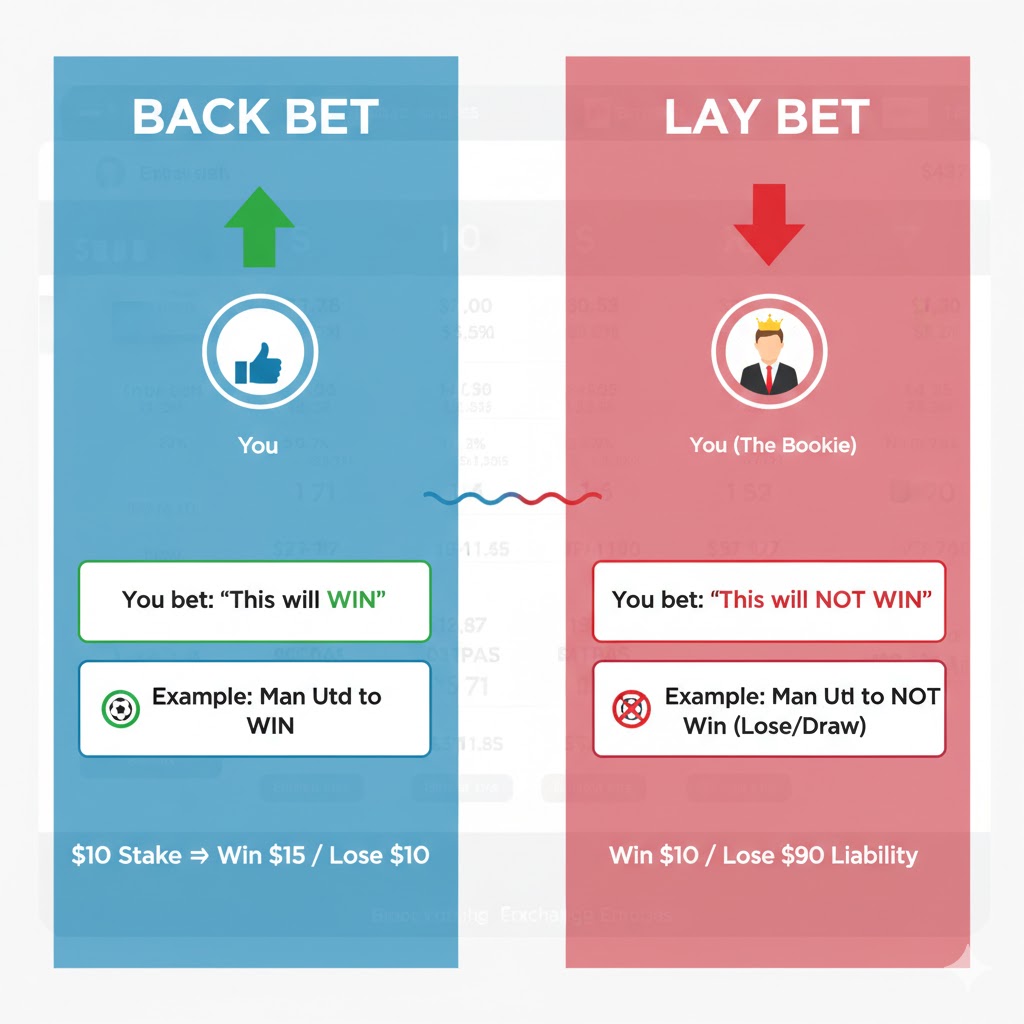
This is the single most important concept to understand. Every bet on an exchange has two sides.
### What is a Back Bet? (The Traditional Bet)
A back bet is the bet you’ve always known. You are backing an outcome to happen.
- You are betting: “This will win.”
- Example: You place a back bet on “Manchester United to win.” If they win, you win. If they lose or draw, you lose your stake.
### What is a Lay Bet? (Acting as the Bookie)
A lay bet is the complete opposite, and it’s what makes exchanges so powerful. You are betting against an outcome happening. You are taking on the role of the bookmaker.
- You are betting: “This will not win.”
- Example: You place a lay bet on “Manchester United to win.” You win your bet if they lose or draw. You only lose if Manchester United does win.
How Does a Betting Exchange Work? (A Step-by-Step Example)
Let’s use a real-world P2P scenario for a cricket match: India vs. Australia.
- Step 1: The “Backer” Arrives.
- User A believes India will win. They want to place a $10 bet on India at odds of $2.5$.
- They place a back bet offer: “I want to bet $10 on India at $2.5$.”
- Step 2: The “Layer” Arrives.
- User B sees this offer. User B thinks India will not win (they will lose).
- User B decides to “play bookie” and accept User A’s bet. They lay India at $2.5$.
- By laying this bet, User B is saying: “I am willing to risk $15 to win User A’s $10 stake if India doesn’t win.” (This risk is their liability).
- Step 3: The Bet is “Matched”.
- The exchange sees both offers, matches them instantly, and holds the money.
- The exchange locks in User A’s $10 stake and User B’s $15 liability.
- Step 4: The Result.
- Scenario A: India wins. User A (the backer) wins. The exchange gives them their $10 stake back, plus User B’s $15. User A has a $15 profit.
- Scenario B: Australia wins. User B (the layer) wins. The exchange gives them their $15 liability back, plus User A’s $10 stake. User B has a $10 profit.
- Step 5: The Commission.
- In Scenario A, User A won $15. The exchange takes its commission from that profit (e.g., 5% of $15 = $0.75).
- In Scenario B, User B won $10. The exchange takes its commission from that profit (e.g., 5% of $10 = $0.50).
Betting Exchange vs Traditional Bookmaker
Here’s a simple breakdown of the key differences:
| Feature | Traditional Bookmaker | Betting Exchange |
| Who You Bet Against | The “House” (The Bookmaker) | Other Users (Peers) |
| Available Bets | Back bets only. | Back bets and Lay bets. |
| The “Cost” | A hidden profit margin (vig/overround) in the odds. | A small, transparent commission on net winnings. |
| The Odds | Set by the bookmaker. Generally poorer value. | Set by users. Generally better, fairer value. |
| Account Restrictions | Successful, winning accounts are often limited or closed. | Winners are welcome (they generate more commission). |
| In-Play Strategy | Place new bets at new odds. | Trade your position to lock in a profit or cut a loss. |
### Is an exchange better than a bookmaker?
For a casual bettor who just wants to place a simple bet, a bookmaker is easier.
For anyone serious about making a long-term profit, yes, an exchange is overwhelmingly better. The global sports betting market is valued at over $100 billion in 2024, and savvy users are migrating to exchanges. The combination of better odds (due to no hidden “overround” margin, which often sits at 5-8% on bookie sites) and the ability to lay and trade gives you a strategic edge that bookmakers simply cannot offer.
A Complete Guide to Back and Lay Betting
What Makes a “Good” Market for Trading?
Before we dive into the best markets to trade on a betting exchange, you need to understand why they are the best. Two factors are critical:
- Liquidity: This is the most important factor. Liquidity is the amount of money available in a market. High liquidity means there are thousands of users and millions of dollars waiting to be matched. This ensures you can get your bets on and off at a fair price, instantly. Low liquidity (like in an obscure volleyball match) means your bet might not get matched at all.
- Volatility: This is the movement of the odds. A good trading market needs price swings. A goal in football, a wicket in cricket, or a horse taking the lead all cause dramatic odds changes. These swings are the opportunities you trade to lock in a profit.
The best markets have high liquidity and predictable volatility.
Best Markets to Trade on a Betting Exchange
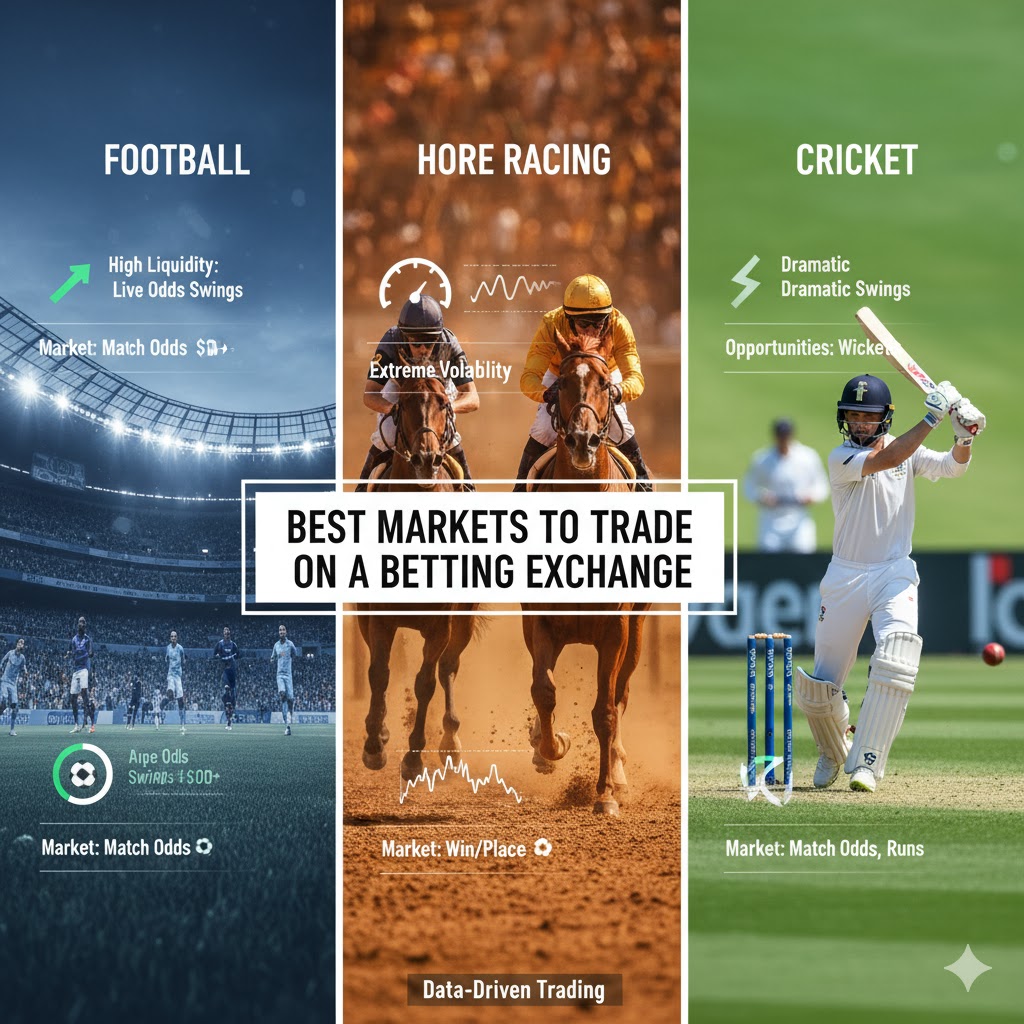
This is the core of our guide. While you can trade any sport, these three are the undisputed kings of the exchange.
### Football: The Global King of Liquidity
Football (soccer) is the most popular sport in the world, and consequently, it has the highest liquidity on betting exchanges. Markets for major leagues (like the English Premier League or Champions League) can have tens of millions of dollars matched on a single game.
- Top Trading Markets:
- Match Odds (1X2): The most liquid market. The odds will swing dramatically based on goals, red cards, and even just the passage of time (the price on the “Draw” will shorten as 0-0 gets closer to 90 minutes).
- Over/Under Goals (e.g., O/U 2.5): A hugely popular trading market. If there’s an early goal, the Over 2.5 price will plummet, and the Under 2.5 price will soar, offering a perfect trading opportunity.
- Correct Score: Less liquid, but offers huge price swings.
- Classic Trading Strategy: “Laying the Draw”
- Find a match where you strongly expect a winner (i.e., not a 0-0 bore-draw).
- Place a lay bet on “The Draw” before the match starts.
- If a team scores, the odds on the draw will drift (get higher).
- You can then place a back bet on “The Draw” at the new, higher price to lock in a guaranteed profit, regardless of whether the leading team holds on or the other team equalizes.
5 Simple Football Trading Strategies for Beginners
### Horse Racing: The Original High-Volatility Market
Horse racing is where betting exchanges first made their name. The markets are incredibly volatile, especially in the 10-15 minutes before a race begins. Millions are matched as expert opinions, “stable-talk,” and money from big players pour in, causing prices to steam (shorten) or drift (lengthen) rapidly.
- Top Trading Markets:
- Win Market: This is the main market. You can trade pre-race or “in-play.”
- Place Market: Bet on a horse to finish in the top 2, 3, or 4. Less volatile, but can be a safer market to trade.
- Classic Trading Strategy: “Pre-Race Swing Trading”
- Watch the odds of a horse 10 minutes before the race.
- You notice its price is steadily shortening (e.g., from $5.0$ down to $4.5$).
- You place a back bet at $4.5$, predicting the trend will continue.
- Five minutes later, the price has shortened to $4.0$.
- You then place a lay bet at $4.0$ to guarantee a profit before the gates even open.
Visit the Responsible Gambling Council for guides on betting safely
### Cricket: A Trader’s Paradise of Swings
Cricket, especially T20 and One Day Internationals (ODIs), is arguably one of the best trading sports on earth. The odds can flip-flop dramatically and repeatedly. One over can see 20 runs scored, and the next can see two wickets fall. This constant, dramatic volatility is a trader’s dream.
- Top Trading Markets:
- Match Odds: The most popular. In a T20, a team can go from being a huge favorite ($1.3$) to an underdog ($3.0$) and back again in the space of 30 minutes.
- Total Innings Runs: You can back or lay a total score and trade your position as the batting team scores (or loses wickets).
- Classic Trading Strategy: “Trading the Wickets” (T20s)
- The batting team is a strong favorite (e.g., $1.4$) to win.
- You anticipate a wicket will fall soon. You place a lay bet on the batting team at $1.4$.
- A key player is dismissed! The batting team’s odds immediately drift to $1.8$.
- You can now back them at $1.8$ to lock in an instant profit. You can repeat this process multiple times throughout the match.
Benefits (Pros) of Exchanges. best markets betting exchange
- Better Odds: By cutting out the bookie’s margin, you get fairer odds.
- The Power to Lay: You can act as the bookie and bet against outcomes.
- Trading: You can “green up” to lock in a guaranteed profit or “red out” to minimize a loss, regardless of the final result.
- No Restrictions: Exchanges welcome winners. Since they make money on commission, they want you to win and trade more. Bookies, in contrast, will ban or limit successful accounts.
Risks (Cons) of Exchanges. best markets betting exchange
- Complexity: The learning curve is steeper. Understanding liability is non-negotiable.
- Commission: You must always factor the commission into your profit calculations.
- Poor Liquidity (on Niche Markets): If you try to trade a low-level sport, you may not find anyone to match your bet. This is why sticking to the markets above is so important.
### The Critical Risk: Understanding “Liability”. best markets betting exchange
This is the most important risk to manage.
When you place a back bet, your risk is simple: your stake.
When you place a lay bet, your risk is your liability. This is the amount of money you must have in your account to cover your loss if you are wrong.
A Simple, Critical Example:
You want to lay a horse at odds of $10.0$ (9/1). You offer to accept a $10 bet from a backer.
- Your Goal: To win the backer’s $10 stake.
- Your Liability Calculation: (Backer’s Stake) x (Odds – 1)
- Your Liability: $10 x ($10.0$ – 1) = **$90**
The exchange will immediately lock $90 from your balance. If the horse loses, you win $10 (minus commission). If the horse wins, you lose $90.
A Full Guide to Betting Exchange Liability
### What is the main risk of a lay bet? best markets betting exchange
The main risk of a lay bet is your liability. As shown above, your potential loss ($90) can be significantly larger than your potential win ($10). This is especially true when laying “longshots” at high odds. Never place a lay bet without checking and understanding your liability.
### Can you lose more than you deposit on a betting exchange?
No. You can never lose more money than you have in your account. To place a lay bet, you must have the full amount of your potential liability in your available balance. The exchange locks this money up, so you are never at risk of going into debt.
Read about UK Gambling Commission rules for P2P betting
Conclusion: Where Should You Start?
While a betting exchange offers endless possibilities, your journey should start with focus. The best markets to trade on a betting exchange are, without question, Football, Horse Racing, and Cricket.
best markets betting exchange, They provide the essential ingredients for success: massive liquidity, ensuring your bets get matched, and constant volatility, providing the price swings you need to trade.
Our advice? Don’t try to trade everything. Pick one of these sports, learn its rhythms, and master one simple strategy, like “Laying the Draw” in football. This focused approach is the fastest path from being a simple punter to a savvy exchange trader.
Frequently Asked Question. best markets betting exchange
1. What is the most liquid market on a betting exchange?
By a large margin, the “Match Odds” (1X2) market for top-tier football matches (like the English Premier League, World Cup, or Champions League) is the most liquid in the world, often with tens of millions of dollars/pounds matched per game.
2. What does it mean to “green up” on an exchange?
“Greening up” is another term for locking in a guaranteed profit, regardless of the outcome. It’s achieved by backing at a high price and laying at a lower price (or vice-versa). Your trading software will show a potential green (profit) number on all possible outcomes.
3. Why are betting exchange odds better than bookmaker odds?
Exchange odds are better because there is no hidden profit margin (overround) built in. The odds are a true reflection of the P2P market. The only fee is the small winner’s commission, which is almost always far lower than a bookie’s hidden margin.
4. What is the difference between trading and gambling?
While both involve risk, “gambling” is typically placing a single bet on an outcome and letting it ride. “Trading” is the process of placing multiple bets (backing and laying) on the same market as the odds move, with the goal of locking in a profit before the event is over, thereby minimizing or eliminating the risk.
5. What is a “matched” vs. “unmatched” bet?
A matched bet is one that has been accepted by another user on the exchange; it is active and “live.” An unmatched bet is an offer you have made (e.g., asking for better odds) that no one has yet agreed to take. It is not an active bet until someone matches it.