Table of Contents
- Introduction: The Betting Revolution You’re Missing(lay betting strategy)
- What Is a Betting Exchange?
- How Does a Betting Exchange Work? A Step-by-Step Example
- Back and Lay Betting Explained
- The Back Bet: The Classic Wager
- The Lay Bet: The Game-Changer
- Betting Exchange vs. Traditional Bookmaker: The Key Differences
- The Core of a Winning Lay Betting Strategy: Understanding Liability
- What is the biggest risk of a lay bet?
- Benefits (Pros) of Using a Betting Exchange
- Is a betting exchange better than a bookmaker?
- Simple Lay Betting Strategy Examples
- Strategy 1: Laying the Over-Hyped Favorite
- Strategy 2: Laying the Draw in Football
- Can you make consistent profit on betting exchanges?
- Conclusion: Embrace the Exchange, Master the Risk
- Frequently Asked Questions (FAQ)
Introduction: The Betting Revolution You’re Missing. lay betting strategy
We’ve all been there. You place a bet on a “sure thing,” only to watch in frustration as your team concedes a last-minute equalizer. With a traditional bookmaker, that’s a lost bet. But what if you could bet against that team from the start? What if you could profit if they failed to win?
This isn’t a fantasy. This is the new reality of sports betting, made possible by betting exchanges.
Forget the old model of you against the “house.” Exchanges are peer-to-peer (P2P) platforms where you bet against other users, not a company. This single change unlocks a powerful new tool: the lay bet. Mastering a lay betting strategy is the key to betting like a professional, giving you the power to “be the bookie” and profit from outcomes not happening.
This guide will break down everything you need to know, from the basics of a back bet and lay bet to the critical concept of liability.
What Is a Betting Exchange? lay betting strategy
Think of a betting exchange like a stock market or eBay, but for sports outcomes. It’s a neutral marketplace that doesn’t set odds or take bets itself. Instead, it simply provides the platform for two users with opposing views to bet against each other.
- One user wants to back an outcome (bet for it to happen).
- Another user wants to lay an outcome (bet against it happening).
The exchange “matches” these two bets. Because the exchange is just a facilitator, it doesn’t care who wins or loses. Its only role is to hold the money and pay the winner. For this service, it takes a small commission on the winner’s net profit, which is typically much lower than a bookmaker’s built-in margin.
How Does a Betting Exchange Work? A Step-by-Step Example
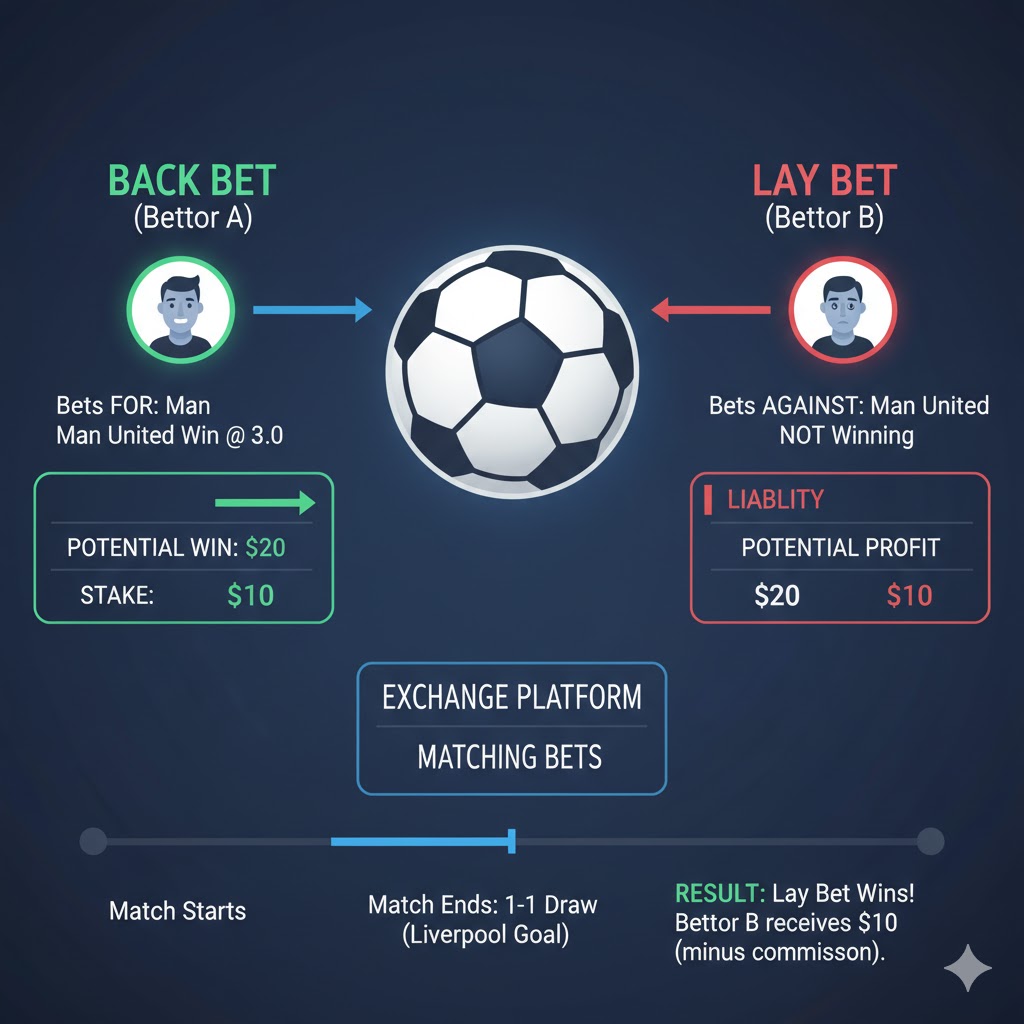
Let’s use a simple example: a Premier League match between Manchester United and Liverpool.
- The Backer (Bettor A): Sarah believes Manchester United will win. She wants to place a $10 back bet on them at odds of 3.0 (2/1). Her potential profit is $20 ($10 $\times$ (3.0 – 1)).
- The Laye (Bettor B): David believes Manchester United will not win (meaning they will either lose or draw). He sees Sarah’s offer and decides to “lay” her bet. He is essentially acting as a bookmaker, offering her the 3.0 odds.
- The Match: The exchange locks in both bets. Sarah has staked $10. David’s liability (the amount he stands to lose) is $20, which is Sarah’s potential profit. The exchange holds this $20 from David’s account.
- The Outcome: The match ends in a 1-1 draw.
- The Payout:
- Sarah’s back bet loses because Manchester United did not win. She loses her $10 stake.
- David’s lay bet wins. He receives Sarah’s $10 stake.
- The exchange then charges David a small commission (e.g., 2%) on his $10 profit. He pays $0.20 in commission and pockets $9.80.
David profited because the team he bet against failed to win. This is the power of a lay bet.
Back and Lay Betting Explained
This is the most crucial concept to grasp. On an exchange, every bet has two sides.
The Back Bet: The Classic Wager. lay betting strategy
This is what you’re already used to. A back bet is a bet for an outcome to happen.
- Example: You back Liverpool to win the league.
- You Win If: Liverpool wins the league.
- You Lose If: Any other team wins the league.
When you place a back bet, you set your stake ($10) and your profit is determined by the odds (e.g., @ 5.0, you profit $40). Your risk is always limited to your stake.
The Lay Bet: The Game-Changer. lay betting strategy
This is the heart of every lay betting strategy. A lay bet is a bet against an outcome happening. You are taking on the role of the bookmaker.
- Example: You lay Liverpool to win the league.
- You Win If: Liverpool does not win the league (i.e., any other team wins).
- You Lose If: Liverpool wins the league.
When you lay bet, you are offering odds to other users. Your potential profit is limited to the backer’s stake you are accepting. Your potential loss, however, is your liability.
Betting Exchange vs. Traditional Bookmaker: The Key Differences
The shift from a bookmaker to an exchange is a fundamental change in how you bet. Here’s a direct comparison:
| Feature | Betting Exchange (P2P) | Traditional Bookmaker (B2C) |
| Who You Bet Against | Other users (Peer-to-Peer). | The “House” or the company. |
| How They Profit | A small commission (e.g., 2-5%) on net winnings only. | A built-in margin (“vig” or “overround”) on all odds, ensuring a profit over time. |
| Odds | Generally better, as they are a true reflection of market supply and demand. | Worse, as they include the bookmaker’s margin. |
| Lay Betting | Yes. You can bet against any outcome. | No. You can only back outcomes the bookmaker offers. |
| Flexibility | High. You can set your own odds and wait for them to be matched. | Low. You must accept the odds the bookmaker gives you. |
A 2019 study highlighted that traditional bookmaker margins (the “vig”) can range from 5% to as high as 10% on certain markets. In contrast, an exchange’s commission model means that, over time, a successful bettor keeps significantly more of their winnings.
See our full list of recommended betting exchanges
The Core of a Winning Lay Betting Strategy: Understanding Liability
We’ve used the word liability several times, and it’s time to face it head-on. This is the single most important concept for anyone using a lay betting strategy. Failing to understand it is the number one reason beginners lose money.
Liability is the amount of money you are risking when you place a lay bet. It’s the amount the exchange reserves from your balance to pay the backer if you lose.
When you back a bet, your risk is your stake. If you bet $10 at 10.0, you risk $10.
When you lay a bet, your risk is your liability.
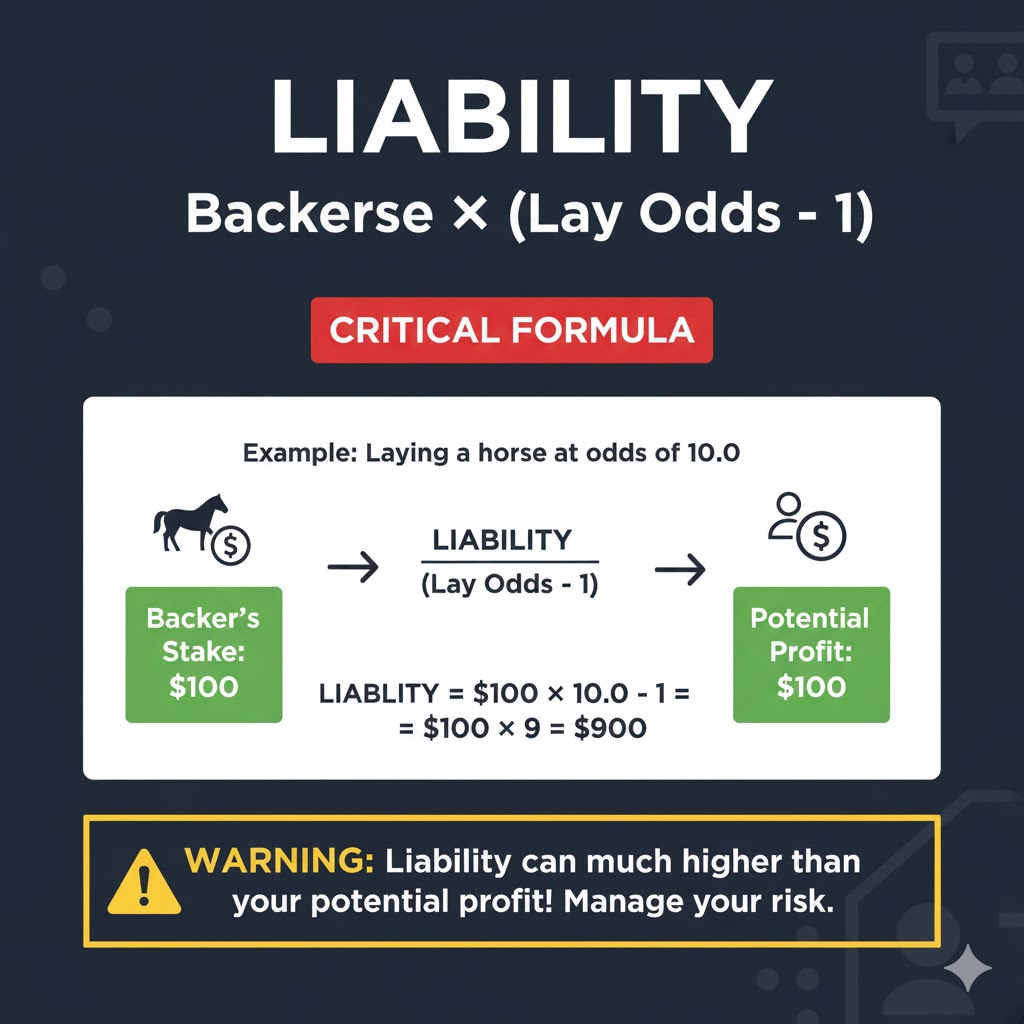
The formula is:
Liability = (Backer’s Stake $\times$ (Lay Odds – 1))
Let’s use an example. You want to lay an underdog horse at odds of 10.0 and you are willing to accept a $10 backer’s stake.
- Your Potential Win: $10 (the backer’s stake), minus commission.
- Your Potential Loss (Liability): $10 $\times$ (10.0 – 1) = $10 $\times$ 9.0 = $90.
You are risking $90 to win $10. The exchange will require you to have at least $90 in your account to even place this bet.
What is the biggest risk of a lay bet?
The biggest risk of a lay bet is your liability, which can be many multiples of your potential profit, especially when laying high-odds outcomes. As shown above, laying a 10.0 shot means you risk 9 times your potential reward. This is why a “get rich quick” lay betting strategy of laying longshots is extremely dangerous and will eventually wipe out your bankroll.
A smart strategy involves laying outcomes at low odds, where your liability is manageable.
Read more about bankroll management and responsible gambling
Benefits (Pros) of Using a Betting Exchange
If liability is so risky, why bother? Because the advantages, when used correctly, are immense.
- Better Odds: By cutting out the bookmaker’s margin, exchanges almost always offer better prices. More value on every bet means more profit in the long run.
- The Power to Lay: This is the obvious one. You can now profit from your knowledge of what won’t happen. You can bet against an out-of-form team, an over-hyped horse, or a tennis player who struggles on clay.
- Trading Opportunities: Exchanges allow you to “trade” a position, just like on the stock market. You can back a team at high odds (e.g., 4.0) and then, if they score and their odds drop, lay them at lower odds (e.g., 2.0) to guarantee a profit regardless of the final result.
- Transparency: You see the “market depth” — all the money waiting to be matched at different odds. There are no hidden margins.
A beginner's guide to sports trading
Is a betting exchange better than a bookmaker?
For a savvy, knowledgeable bettor, an exchange is almost always better due to superior odds and the flexibility of lay betting. However, for a complete beginner, it can be more complex. The P2P model means your bet isn’t guaranteed to be matched if you ask for unrealistic odds. Furthermore, the concept of liability presents a new risk that bookmaker-only users never face.
Simple Lay Betting Strategy Examples
A good lay betting strategy is not about high-risk, high-reward bets. It’s about finding value and managing risk. The global sports betting market is valued at over $200 billion, and a large portion of this is now flowing through P2P exchanges.
Here are two simple, foundational strategies.
Strategy 1: Laying the Over-Hyped Favorite
- The Concept: A top-tier team (e.g., Real Madrid) is playing an away game against a solid mid-table team. The public piles on Real Madrid, and their back odds drop to an artificially low 1.30.
- The Strategy: You believe these odds are too short and don’t reflect the true risk. You decide to lay Real Madrid at 1.30.
- The Math: You accept a $100 stake from a backer.
- Your Liability: $100 $\times$ (1.30 – 1) = $30.
- Your Potential Win: $100.
- The Outcome: You are risking just $30 to win $100. You win your bet if Real Madrid either loses or draws the match. This strategy provides excellent, low-risk value.
Strategy 2: Laying the Draw in Football
- The Concept: This is one of the most popular strategies. In a football match where you expect a winner (e.g., two attacking teams), you can lay the draw.
- The Strategy: Before kick-off, you lay the draw at odds of, for example, 3.50.
- The Outcome: If the match ends 0-0, 1-1, etc., you lose your bet. But if either team wins (1-0, 2-1, 0-3), your lay bet is a winner.
- Advanced Tweak: This is also a popular trading strategy. You lay the draw, and if a goal is scored, the odds on the draw will rise significantly. You can then back the draw at the new, higher odds to lock in a guaranteed profit.
Can you make consistent profit on betting exchanges?
Yes, it is possible, but it must be treated like trading, not gambling. Consistent profit doesn’t come from “lucky lays.” It comes from disciplined strategy, solid bankroll management, and a deep understanding of value and liability. No lay betting strategy is a guaranteed winner, but it gives you a professional-grade tool that was previously unavailable to the average bettor.
Conclusion: Embrace the Exchange, Master the Risk
The move to a betting exchange is the single biggest leap you can take in your betting journey. It fundamentally changes the game from a simple “win/lose” bet against a bookie to a dynamic market of backing, laying, and trading.
A lay betting strategy unlocks the door to profiting when others are wrong, allowing you to “be the bookie” and win even when a team fails to perform. The key is to treat it with respect. Always calculate your liability before placing a bet, start with small stakes, and never lay high-odds outcomes you can’t afford to pay out.
Master this one concept, and you’ll have an edge that 90% of traditional bettors simply don’t have.
Advanced Lay Betting and Trading Strategies
The Legal Landscape of Betting Exchanges in Your Region
Frequently Asked Questions (FAQ)
What is the main difference between a back bet and a lay bet?
A back bet is a traditional bet for something to happen (e.g., “I bet Team A will win”). A lay bet is a bet against something happening (e.g., “I bet Team A will not win”). You win your lay bet if Team A loses or draws.
Do I pay commission on all my bets on an exchange?
No. Betting exchanges typically only charge a small commission on your net winnings for a specific event. If you place a bet and lose, you do not pay any commission.
What does it mean to ‘be the bookie’?
This phrase refers to placing a lay bet. When you lay an outcome, you are offering odds to other bettors and agreeing to pay them if they win, just as a traditional bookmaker does. Your profit is the stake you accept if their bet loses.
Is lay betting riskier than back betting?
It can be if not managed properly. With a back bet, your maximum loss is your stake. With a lay bet, your maximum loss is your liability, which can be significantly higher than your potential profit, especially at high odds. However, a lay betting strategy focused on low-odds outcomes can be less risky.
What is a good beginner lay betting strategy?
A good beginner strategy is “laying the favorite” at very low odds (e.g., 1.50 or less) in matches where you believe an upset (a draw or a loss) is possible. This keeps your liability extremely low (risking $50 to win $100 at odds of 1.50) while giving you two out of three possible outcomes (draw or loss) to win your bet.